
Chatbot vs Live Chat: Which Is Better for Customer Service? | HODS
Chatbot vs live chat for customer service — compare cost, availability, response time, and customer satisfaction. Find the right solution for your business.
AUTOMATION
2/10/202618 min read


Quick Answer: Chatbots handle high-volume, repetitive queries 24/7 at near-zero marginal cost. Live chat provides personalized support for complex issues that require human judgment. Most businesses benefit from both: chatbots handle 60–80% of inquiries automatically, while live agents handle escalations.
Introduction: The Digital Customer Service Revolution
In today's fast-paced digital landscape, customer service automation has become a critical component of business success. Companies worldwide are asking the same question: should we invest in AI-powered chatbots or stick with traditional live chat support? The answer isn't always straightforward, as both chatbot technology and live chat software offer unique advantages for modern customer support teams.
The customer service chatbot market has experienced exponential growth, with businesses increasingly adopting automated customer service solutions to meet rising consumer expectations. Meanwhile, live chat agents continue to provide the human touch that many customers still prefer. Understanding the differences between these two powerful tools is essential for any business looking to enhance their customer experience while optimizing operational costs.
In this comprehensive guide, we'll explore everything you need to know about chatbot vs live chat solutions, helping you make an informed decision for your customer service strategy. Whether you're a small business owner, a customer service manager, or an enterprise decision-maker, this comparison will provide actionable insights to transform your customer support operations.
When to Use a Chatbot
• Your support team receives the same questions repeatedly (FAQs, order tracking, pricing)
• You need 24/7 availability but cannot staff a round-the-clock support team
• You want to qualify leads automatically before they reach your sales team
• Your website visitors need instant responses to convert — not a 'we'll call you back' form
When Live Chat Is the Right Choice
• Your product is complex and customers need a conversation to make a purchase decision
• You are selling high-ticket items where personalization significantly affects conversion
• Your customers have complained about impersonal or frustrating automated responses
• You have a small, consistent volume of enquiries your team can manage in real time
The Best Approach: Combine Both
The most effective customer service setups use AI chatbots to handle the first layer — answering FAQs, collecting contact details, routing inquiries — and escalate to a live agent when the conversation requires human judgment. This is the hybrid model HODS builds into every chatbot deployment.
Q: How much does a business chatbot cost?
HODS custom chatbot development starts from $500 for a basic FAQ bot and scales to $3,000+ for a fully integrated AI chatbot with CRM connectivity, WhatsApp integration, and custom conversation flows.
Q: Can a chatbot replace my customer service team?
Not entirely — and it shouldn't try to. A well-built chatbot can handle 60–80% of routine queries automatically, freeing your team to focus on complex and high-value interactions. Think of it as a first-line responder, not a replacement.
What is Live Chat Support?
Live chat support is a real-time messaging system that connects customers directly with human customer service representatives through a chat interface on your website or mobile app. Unlike traditional phone support or email communication, live chat provides instant communication between customers and trained support agents who can address concerns, answer questions, and resolve issues in real time.
Modern live chat software comes equipped with advanced features including chat routing, file sharing, co-browsing capabilities, and integration with customer relationship management systems. Support agents can typically handle three to four simultaneous conversations, making it a more efficient alternative to phone support while maintaining the personal connection that customers value.
The best live chat tools offer omnichannel support, allowing businesses to manage conversations across multiple platforms including WhatsApp, Facebook Messenger, Instagram, and website chat widgets from a single unified inbox. This multi-channel approach ensures customers can reach your business through their preferred communication channel while your team maintains complete visibility over all interactions.
Live chat agents bring human empathy, emotional intelligence, and critical thinking to customer interactions. They can adapt their communication style based on customer emotions, handle complex problem-solving scenarios, and make judgment calls that automated systems simply cannot replicate. This human element becomes particularly valuable when dealing with frustrated customers, handling sensitive account issues, or providing personalized product recommendations based on nuanced customer needs.
However, live chat support does come with limitations. Human agents require regular training, work specific shifts, need breaks, and can experience fatigue or burnout during high-volume periods. The cost of maintaining a 24/7 live chat team can be substantial, especially for growing businesses with increasing customer service demands. Additionally, response times can vary significantly depending on agent availability and current workload.
Understanding AI Chatbots for Customer Service
AI chatbots represent a significant advancement in customer service technology, utilizing artificial intelligence, natural language processing, and machine learning to simulate human-like conversations with customers. Unlike simple rule-based bots that follow predetermined scripts, modern AI-powered chatbots can understand context, learn from interactions, and provide increasingly sophisticated responses over time.
Customer service chatbots excel at handling repetitive queries, frequently asked questions, and routine transactions without human intervention. They can process order status inquiries, provide product information, guide users through troubleshooting steps, collect customer data, and even complete simple transactions like password resets or appointment scheduling. The most advanced chatbot solutions can understand multiple languages, detect customer sentiment, and seamlessly escalate complex issues to human agents when necessary.
One of the most compelling advantages of chatbot technology is its ability to provide instant responses around the clock. While live chat agents need sleep and time off, chatbots maintain consistent availability 365 days a year without degradation in performance quality. This 24/7 customer support capability ensures that customers in different time zones or those contacting your business outside regular hours still receive immediate assistance.
Chatbots also demonstrate remarkable scalability. A single chatbot can handle unlimited simultaneous conversations without any decrease in response quality or speed. During peak traffic periods, product launches, or promotional campaigns, chatbots can manage massive inquiry volumes that would otherwise overwhelm even large customer service teams. This scalability makes chatbots particularly valuable for e-commerce businesses, SaaS companies, and any organization experiencing rapid growth.
The implementation of AI chatbots has shown measurable business impact. Research indicates that chatbots can deflect up to 60% of incoming customer support queries, allowing human agents to focus their expertise on complex issues that genuinely require human judgment. This ticket deflection not only reduces operational costs but also improves overall customer satisfaction by providing faster resolutions to common problems.
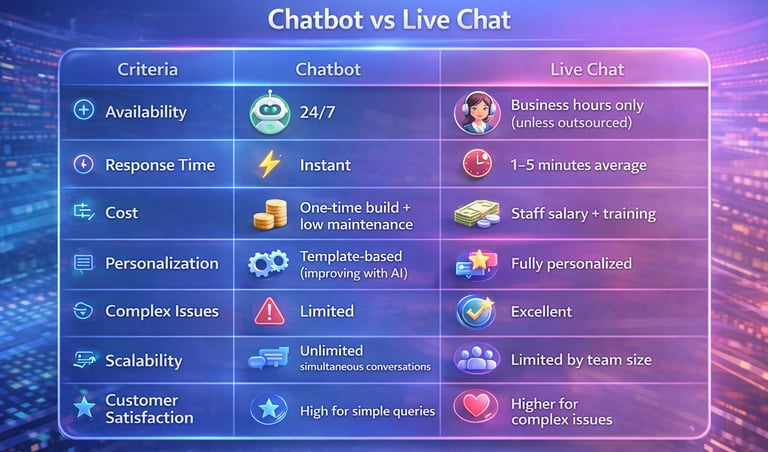
Chatbot vs Live Chat: Key Differences Explained
Understanding the fundamental differences between chatbot and live chat solutions is crucial for making the right choice for your business. While both tools facilitate real-time customer communication, they differ significantly in operation, capabilities, costs, and ideal use cases.
The most obvious distinction lies in the nature of the interaction itself. Live chat connects customers with real human beings who bring emotional intelligence, creative problem-solving abilities, and the capacity for genuine empathy to each conversation. Human agents can read between the lines, detect frustration in customer messages, adjust their tone accordingly, and make contextual decisions based on situational nuances. Chatbots, conversely, rely on programmed algorithms and machine learning models to generate responses. While advanced AI chatbots have become remarkably sophisticated at mimicking human conversation, they still operate within defined parameters and may struggle with highly unusual queries or emotionally complex situations.
Response speed represents another critical difference. Chatbots provide instantaneous replies to customer inquiries, with response times measured in milliseconds rather than seconds or minutes. This immediacy significantly enhances customer experience, particularly for straightforward questions that don't require deep analysis. Live chat agents, while generally quick compared to email or phone support, still require time to read messages, process information, and formulate appropriate responses. The average live chat response time typically ranges from 30 to 45 seconds, which may feel slow to customers accustomed to instant digital interactions.
Availability patterns also differ dramatically between these two solutions. Implementing 24/7 live chat support requires either hiring multiple shifts of support agents or outsourcing to global teams, both of which involve substantial ongoing costs. Most businesses limit live chat availability to standard business hours or peak traffic periods. Chatbots, however, operate continuously without breaks, holidays, or shift changes. This permanent availability ensures consistent customer support regardless of when customers need assistance.
Cost considerations present yet another major distinction. Live chat involves ongoing expenses including agent salaries, training programs, software subscriptions, and management overhead. These costs scale linearly with business growth, as more customers typically require more support agents. Chatbot implementation often involves higher upfront development and integration costs, but ongoing expenses remain relatively static regardless of conversation volume. For businesses handling thousands of monthly support inquiries, chatbots frequently prove more cost-effective over time.
The nature of conversations handled also differs between these tools. Live chat excels at complex problem-solving, nuanced discussions, sales conversations requiring persuasion, and situations where customer emotions run high. Human agents can deviate from scripts, think creatively, and apply business knowledge to unique scenarios. Chatbots perform best with routine inquiries, information retrieval tasks, simple transactions, and any interaction that follows predictable patterns. They struggle with ambiguous requests, entirely novel situations, or conversations requiring subjective judgment.
When to Use Live Chat for Customer Support
Live chat support proves particularly valuable in specific business scenarios where human judgment, emotional intelligence, and personalized service create meaningful competitive advantages. Understanding when to deploy live chat helps maximize its impact while controlling costs.
High-value sales situations represent an ideal use case for live chat. When customers are considering expensive purchases, complex service packages, or customized solutions, speaking with a knowledgeable human representative can significantly increase conversion rates. Live chat agents can answer specific product questions, address unique customer concerns, highlight relevant features based on individual needs, and provide the reassurance that often pushes hesitant prospects toward purchasing decisions. Research shows that customers engaging with live chat during the purchasing process demonstrate higher conversion rates compared to those who don't interact with support.
Technical troubleshooting scenarios also benefit tremendously from human expertise. When customers face complex technical issues, live chat agents can ask clarifying questions, request screenshots, guide users through multi-step solutions, and adapt their approach based on customer technical proficiency. The back-and-forth dialogue that characterizes effective troubleshooting requires the flexibility and contextual understanding that human agents provide better than current chatbot technology.
Businesses in industries requiring empathy and emotional support should prioritize live chat. Healthcare providers, financial advisors, insurance companies, and crisis support services all handle sensitive situations where customers may feel stressed, confused, or upset. Human agents can provide genuine empathy, adjust their communication style based on customer emotional states, and handle delicate conversations with the tact and discretion that automated systems cannot replicate.
Premium customer service brands that differentiate themselves through exceptional support experiences should invest in live chat with highly trained agents. Luxury retailers, concierge services, and businesses targeting high-net-worth individuals often find that white-glove human support aligns with brand positioning and customer expectations better than automated alternatives.
Small businesses and startups with limited inquiry volumes may find live chat more practical than implementing chatbot systems. When you're receiving fewer than 50 customer inquiries daily, the cost and complexity of developing, training, and maintaining a chatbot may not justify the investment. Simple live chat software with part-time agents can provide excellent coverage without overextending resources.
When Chatbots Make More Sense for Your Business
Certain business situations make customer service chatbots the superior choice for handling customer inquiries efficiently and cost-effectively. Recognizing these scenarios helps businesses deploy chatbot technology where it delivers maximum value.
High-volume, repetitive query handling represents the sweet spot for chatbot deployment. If your customer support team repeatedly answers the same questions about business hours, shipping policies, return procedures, account access, pricing information, or product availability, a chatbot can handle these inquiries instantly and consistently. This frees human agents to focus on complex issues requiring genuine expertise while still providing excellent service for routine questions.
E-commerce businesses experience particular benefits from chatbot implementation. Online shoppers frequently need quick information about order status, delivery tracking, size guides, payment options, and return policies. Chatbots excel at retrieving this information from connected databases and presenting it conversationally. They can also provide product recommendations based on browsing behavior, remind customers about abandoned carts, and facilitate simple transactions without human intervention.
Businesses operating globally or serving customers across multiple time zones need the 24/7 availability that chatbots provide. Rather than maintaining round-the-clock human staff or leaving international customers without support during local business hours, chatbots ensure consistent service regardless of when customers reach out. This continuous availability particularly benefits SaaS companies, digital services, and any business with significant international customer bases.
Lead generation and qualification represent another strong chatbot use case. Chatbots can engage website visitors proactively, ask qualifying questions, collect contact information, schedule demonstrations, and route qualified leads to appropriate sales representatives. This automated lead capture operates continuously without requiring sales staff to monitor chat windows constantly.
Companies experiencing rapid growth often find chatbots essential for scaling customer support without proportionally scaling headcount. As customer bases expand, chatbots can handle the increased inquiry volume without additional hiring, training, or management overhead. This scalability allows businesses to maintain service quality during growth phases when budgets may be constrained.
Seasonal businesses facing dramatic fluctuations in customer service demand benefit from chatbot flexibility. Rather than hiring and training temporary staff for peak seasons, chatbots can absorb the increased volume while permanent staff handles overflow and complex issues. This approach reduces seasonal hiring costs while maintaining service levels during busy periods.
The Hybrid Approach: Combining Chatbot and Live Chat
The most effective customer service strategies increasingly involve hybrid models that strategically combine chatbot automation with live chat human support. This integrated approach leverages the strengths of both technologies while minimizing their respective limitations.
In hybrid customer support systems, chatbots typically serve as the first line of customer interaction. When customers initiate conversations, the chatbot engages immediately, gathers basic information, determines inquiry nature, and attempts resolution using its knowledge base. For simple, routine queries within the chatbot's capability, the interaction concludes quickly without human involvement. However, when the chatbot encounters complex questions, detects customer frustration, or receives explicit requests for human assistance, it seamlessly escalates the conversation to available live chat agents.
This escalation process should feel natural and frictionless to customers. The best hybrid systems transfer complete conversation history to human agents, ensuring customers don't need to repeat information. Agents receive context about previous chatbot interactions, attempted solutions, and customer details before joining the conversation. This smooth handoff maintains continuity and prevents the frustrating experience of starting over with a human representative.
Implementing effective hybrid support requires thoughtful chatbot training and clear escalation triggers. Businesses must identify which question types their chatbot can handle confidently and which should immediately route to humans. Common escalation triggers include specific keywords indicating frustration, questions about sensitive topics like billing disputes, requests involving account security, or repeated chatbot failures to understand customer queries.
The business benefits of hybrid approaches prove substantial. Companies implementing combined chatbot and live chat systems typically see 30-50% reductions in support costs while maintaining or improving customer satisfaction scores. Chatbots handle the high-volume simple inquiries cost-effectively, while human agents apply their expertise exclusively to situations genuinely requiring human judgment. This division of labor optimizes resource allocation and improves team morale by reducing agent burnout from repetitive tasks.
Customer preferences also support hybrid approaches. While research shows that roughly half of customers prefer speaking with humans for support issues, many are comfortable with chatbot interactions for simple questions. The key is giving customers choice and ensuring easy access to human support when needed. Hybrid systems accommodate both preferences, providing automated efficiency for those who value speed and human interaction for those who value personal connection.
How to Choose Between Chatbot and Live Chat
Selecting the right customer service solution for your specific business requires careful analysis of your unique circumstances, customer base, resources, and strategic priorities. Several key factors should guide this decision-making process.
Start by analyzing your customer inquiry patterns. Review your existing support tickets, emails, and phone calls to identify common themes. If 60-70% of inquiries involve routine questions with straightforward answers, chatbots can likely handle the majority of your volume. Conversely, if most inquiries involve unique situations, complex problems, or require personalized recommendations, live chat with human agents may prove more effective. Consider conducting this analysis quarterly, as inquiry patterns often shift with product evolution and customer base changes.
Budget constraints play a significant role in this decision. Calculate the total cost of ownership for each option over a three-year period. For live chat, include agent salaries or outsourcing fees, training costs, software subscriptions, and management overhead. For chatbots, include development or platform costs, integration expenses, ongoing maintenance, and periodic training updates. While chatbots often demonstrate better long-term ROI for high-volume situations, live chat may prove more cost-effective for businesses with limited inquiry volumes or highly specialized support needs.
Evaluate your team's technical capabilities honestly. Implementing and maintaining chatbot systems requires technical expertise in areas like natural language processing, integration APIs, and ongoing training optimization. If your team lacks these skills, you'll need to budget for external developers or opt for user-friendly no-code chatbot platforms. Live chat implementation typically involves less technical complexity, making it more accessible for small businesses without dedicated IT resources.
Consider your industry and customer demographics carefully. Certain industries face regulatory requirements or customer expectations that favor human interaction. Healthcare, legal services, and financial advising often require human judgment and accountability. Similarly, if your target customers skew older, they may prefer speaking with human representatives over chatbots. Conversely, tech-savvy younger demographics typically embrace chatbot interactions readily.
Assess your growth trajectory and scalability needs. If you anticipate rapid customer base expansion, evaluate whether each solution can scale appropriately. Chatbots scale almost infinitely without additional cost, while live chat requires proportional team growth. Consider not just current needs but where your business will be in 12-18 months.
Finally, don't overlook the option of starting small and expanding gradually. Many businesses successfully begin with simple live chat during business hours, analyze common inquiry patterns, then gradually introduce chatbots for routine questions while maintaining human support for complex issues. This phased approach minimizes risk and allows learning from real customer interactions.
Implementation Best Practices for Maximum ROI
Successfully implementing either chatbot or live chat solutions requires attention to best practices that maximize return on investment while delivering exceptional customer experiences.
For chatbot implementation, begin with comprehensive knowledge base development. Your chatbot's effectiveness depends entirely on the quality and completeness of information it can access. Document common customer questions, create clear answers, anticipate follow-up questions, and organize information logically. Include edge cases and variations in how customers might phrase similar questions. Regularly update this knowledge base as products evolve and new questions emerge.
Invest time in chatbot personality development that aligns with your brand voice. Whether your brand is professional and formal, friendly and casual, or playful and irreverent, your chatbot should match this tone consistently. Write sample conversations that demonstrate how your chatbot should respond in various scenarios. Include appropriate use of emojis, capitalization, and sentence structure that feels natural to your target audience.
Implement robust analytics and continuous improvement processes for chatbot performance. Track metrics including conversation completion rates, escalation frequency, customer satisfaction scores for chatbot interactions, and common failure points where the chatbot cannot answer questions. Review these analytics weekly initially, then monthly once performance stabilizes. Use insights to expand the knowledge base, improve response phrasing, and adjust escalation triggers.
For live chat implementation, prioritize comprehensive agent training that covers product knowledge, communication skills, and software proficiency. Create detailed training materials including common scenarios, approved responses, escalation procedures, and brand voice guidelines. Conduct regular refresher training to maintain quality standards and introduce new features or policies.
Establish clear performance metrics and quality assurance processes for live chat teams. Monitor metrics like average response time, conversation resolution rates, customer satisfaction scores, and concurrent chat handling capacity. Review chat transcripts regularly to identify coaching opportunities and recognize excellent service. Consider implementing peer review processes where agents evaluate each other's conversations constructively.
Optimize chat widget placement and visibility on your website. Test different positions, colors, and trigger behaviors to maximize engagement without being intrusive. Consider proactive chat invitations on high-value pages like pricing or checkout, while using passive availability on informational pages. A/B test different approaches to find what works best for your specific audience.
Whether implementing chatbots or live chat, ensure seamless integration with your existing customer relationship management system, helpdesk software, and other business tools. This integration provides agents or chatbots with customer context, previous interaction history, and account details that enable more personalized and effective support.
Measuring Success: Key Metrics for Customer Service
Tracking appropriate metrics helps businesses evaluate chatbot and live chat performance objectively and identify improvement opportunities. Different metrics matter for different goals, but several key indicators apply universally.
Customer satisfaction score stands as perhaps the most important metric for any customer service solution. Survey customers after chat interactions to gauge satisfaction levels. Aim for CSAT scores above 85% for live chat and above 75% for chatbot interactions. Lower scores indicate problems requiring attention, whether inadequate training, poor knowledge base quality, or technical issues.
First response time measures how quickly customers receive initial replies after initiating contact. For chatbots, this should be instantaneous. For live chat, aim for average first response times under 30 seconds. Longer wait times increase abandonment rates and decrease satisfaction.
Average resolution time tracks how long complete issue resolution takes. This metric varies significantly by inquiry type, but identifying trends helps optimize both chatbot flows and agent processes. If resolution times steadily increase, investigate whether knowledge gaps, technical issues, or workflow inefficiencies are causing delays.
Conversation completion rate indicates what percentage of customer interactions reach successful conclusion without abandonment. High abandonment rates suggest frustration with wait times, inability to resolve issues, or poor user experience. For chatbots specifically, completion rates below 60% warrant investigation into whether the bot is meeting customer needs.
Escalation rate measures how frequently chatbots transfer conversations to human agents. While some escalation is expected and healthy, excessively high rates (above 40-50%) suggest the chatbot is poorly trained or attempting to handle overly complex scenarios. Very low escalation rates (below 10%) might indicate the chatbot is trying to handle issues beyond its capability rather than appropriately escalating.
Future Trends in Customer Service Technology
The customer service landscape continues evolving rapidly as artificial intelligence advances and customer expectations shift. Understanding emerging trends helps businesses prepare for future changes and make forward-thinking technology investments.
Conversational AI is becoming increasingly sophisticated, narrowing the gap between chatbot and human conversation quality. Next-generation natural language processing enables chatbots to understand context, remember previous conversations, detect emotional nuance, and generate more natural responses. Within the next few years, many customers may struggle to distinguish between well-designed chatbots and human agents in text-based conversations.
Voice-enabled customer service represents a growing trend as speech recognition technology improves. Customers increasingly prefer speaking naturally rather than typing, driving adoption of voice chatbots and voice-based support systems. Businesses should consider how voice interfaces might complement or replace text-based chat in their customer service strategies.
Omnichannel support integration will become table stakes rather than competitive advantage. Customers expect seamless transitions between communication channels, whether they start conversations via website chat, continue via WhatsApp, and conclude through email. Future customer service platforms will need to maintain complete context across all channels without requiring customers to repeat information.
Predictive customer service using AI and machine learning will enable proactive support outreach before customers even realize they have issues. By analyzing usage patterns, system data, and historical trends, intelligent systems can identify potential problems and reach out with solutions preemptively. This shift from reactive to proactive support fundamentally changes the customer service paradigm.
Conclusion: Making the Right Choice for Your Business
The chatbot vs live chat debate ultimately presents a false choice for most businesses. Rather than selecting one solution exclusively, the most effective customer service strategies thoughtfully combine both technologies to leverage their complementary strengths.
Chatbots excel at providing instant responses to routine inquiries, operating continuously without breaks, scaling effortlessly during high-demand periods, and reducing operational costs through automation. They make particular sense for businesses handling high volumes of repetitive questions, operating globally across time zones, or experiencing rapid growth requiring scalable support solutions.
Live chat offers irreplaceable human empathy, emotional intelligence, complex problem-solving abilities, and personalized service that create memorable customer experiences. It proves essential for high-value sales conversations, technical troubleshooting, emotionally sensitive situations, and any interaction requiring creative thinking or subjective judgment.
The winning strategy for most businesses involves implementing hybrid systems where chatbots handle routine inquiries efficiently while seamlessly escalating complex issues to skilled human agents. This approach optimizes resource allocation, controls costs, and ensures customers receive appropriate support regardless of inquiry complexity.
When making your decision, analyze your specific customer inquiry patterns, budget constraints, technical capabilities, industry requirements, and growth trajectory. Start with clear metrics for success, implement thoroughly with attention to best practices, and continuously optimize based on performance data and customer feedback.
Ready to transform your customer service experience? Whether you choose chatbots, live chat, or a hybrid approach, the team at HODS.io can help you implement the perfect solution for your business needs. Our expertise in customer service automation, AI chatbot development, and live chat optimization ensures you get maximum ROI while delighting your customers. Contact us today to discuss how we can elevate your customer support to the next level.
Frequently Asked Questions
Q: Can chatbots completely replace live chat agents? A: While chatbots can handle many routine inquiries, they cannot fully replace human agents for complex problem-solving, emotional situations, or conversations requiring creativity and judgment. The best approach combines both technologies.
Q: How much can businesses save by implementing chatbots? A: Studies show businesses can reduce customer service costs by 30-50% when implementing chatbots for routine inquiries while maintaining human support for complex issues. Actual savings depend on inquiry volume and implementation quality.
Q: What response time should I expect from live chat vs chatbot? A: Chatbots provide instantaneous responses, while live chat agents typically respond within 30-45 seconds on average. Both are significantly faster than email or phone support.
Q: Do customers prefer chatbots or live chat? A: Customer preferences vary. Approximately 49% prefer human support, 25% say it depends on the issue complexity, and 12% prefer chatbots. Younger demographics are generally more comfortable with chatbot interactions.
Q: How long does it take to implement a customer service chatbot? A: Implementation timelines vary from a few days for simple rule-based chatbots using no-code platforms to several weeks or months for sophisticated AI-powered chatbots requiring custom development and extensive training.








Ready to Grow Your Startup?
Partner with House of Digital Solutions, a digital marketing agency for startups that understands your journey. Whether you're launching your first product, seeking your initial customers, or scaling to the next level, HODS provides the online marketing services for small business that drive real, measurable growth.
POLICIES
SIGN UP
email: info@hods.io
Call : +92 318 249 5037
© 2025. All rights reserved by House of Digital Solutions
+44 759 968 2726
IMPACT
sales@hods.io
support@hods.io