
How to Publish an eBook Successfully: Platforms, Pricing & Marketing Explained
Professional eBook publishing is no longer optional—it’s strategic. From market insights and platform selection to pricing, distribution, and promotion, the right publishing approach helps authors turn ideas into scalable digital assets and long-term revenue.
E-BOOKS
12/15/20258 min read


Introduction: Why eBook Publishing Is One of the Fastest-Growing Opportunities for Authors
The publishing industry has undergone a fundamental transformation over the last decade, with eBooks emerging as a powerful and sustainable medium for authors worldwide. What was once considered an alternative to print publishing is now a mainstream revenue channel, driven by digital consumption habits, mobile accessibility, and global distribution platforms. For new and experienced authors alike, eBook publishing offers unprecedented control, scalability, and reach—without the traditional barriers imposed by print publishing houses.
Unlike physical books, eBooks eliminate inventory costs, reduce distribution friction, and allow instant global availability. Readers can purchase, download, and start reading within seconds, making eBooks an ideal format for modern consumption patterns. As Seth Godin, publishing innovator and author, states: “Publishing is no longer about printing books—it’s about building permission, connection, and trust.” eBooks enable exactly that by allowing authors to connect directly with their audience.
This blog explores the complete eBook publishing ecosystem, including market potential, global platform performance, customer preferences, pricing strategies, genre trends, and step-by-step processes for author success. It is designed to help new authors understand not only how to publish an eBook, but also how to make it commercially and strategically successful.
The Global Potential of the eBook Market
The global eBook market continues to demonstrate steady growth despite shifts in content consumption formats. Digital reading has become deeply integrated into daily life due to smartphones, tablets, dedicated eReaders, and cloud-based libraries. The convenience of portability, adjustable fonts, instant access, and lower pricing has made eBooks especially popular among younger readers, professionals, and international audiences.
From a business perspective, eBooks offer high profit margins. Once written and formatted, an eBook can be sold repeatedly with minimal additional cost. This scalability makes eBook publishing particularly attractive for independent authors, educators, coaches, and subject-matter experts. Unlike traditional publishing models, authors retain creative control, pricing authority, and a higher percentage of royalties.
Another key factor driving eBook market growth is globalization. Digital platforms remove geographical barriers, enabling authors to sell their books in multiple countries without dealing with logistics, customs, or physical distribution networks. This global reach is especially valuable for niche topics, where a localized print audience may be limited but a global digital audience is substantial.
Furthermore, subscription-based reading platforms and digital libraries have introduced new revenue streams. Authors can now earn through page reads, licensing, and recurring consumption rather than relying solely on one-time purchases. These evolving monetization models continue to expand the long-term earning potential of eBooks.
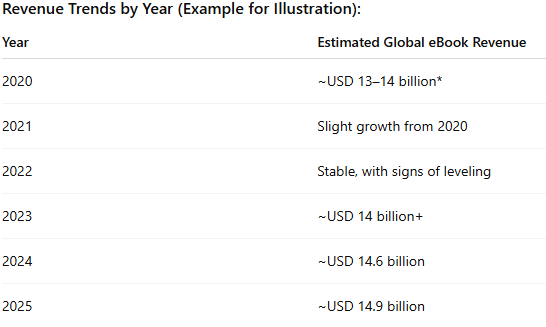
eBook Market Stats: 2020–2025 (Sales & Growth)
Global eBook Market Size & Revenue
Across the global publishing industry, the digital book market has shown steady growth with increasing reader adoption year over year:
The global eBook market value is projected at ~$14.9 billion in 2025, rising gradually from previous years. Whop+1
Reader penetration (the percentage of the population that reads eBooks) is expected to reach ~13.7% in 2025 and continue expanding toward ~14.6% by 2030. Statista
The number of eBook readers worldwide is projected to exceed ~1.2 billion by 2030, illustrating long-term adoption. Statista
*Note: Exact annual breakdowns vary by
source and platform calculation methods.
These approximate values align with
Statista growth projections. Statista
Overall, the global eBook market has
stabilized after pandemic-driven
consumption spikes in 2020 but continues
a moderate upward trajectory. Market
analysts estimate ongoing
CAGR of ~1.2–5% in the mid-term leading up to 2030. Statista+1
How Reader Behavior Is Shaping the eBook Industry
Understanding reader behavior is essential for authors entering the eBook market. Modern readers value speed, accessibility, and relevance. They are more likely to purchase books that solve a specific problem, deliver targeted knowledge, or provide engaging entertainment in a concise format. This shift has led to the rise of shorter eBooks, practical guides, and series-based publishing strategies.
Mobile reading has significantly influenced content structure. Readers often consume eBooks in short sessions—during commutes, breaks, or before sleep. As a result, clear formatting, logical chapter breaks, and engaging introductions have become critical success factors. Authors who adapt their writing style to digital reading habits tend to perform better in terms of completion rates and reviews.
Customer trust also plays a major role. Reviews, ratings, cover design, and author branding strongly influence purchase decisions. According to publishing expert Jane Friedman, “Readers don’t discover books—they discover authors.” This emphasizes the importance of positioning eBooks not as standalone products, but as part of a long-term author brand.
Additionally, readers increasingly rely on algorithms and recommendations. Platform optimization—through keywords, categories, pricing, and metadata—directly impacts visibility. This makes eBook publishing both a creative and technical process, requiring strategic planning beyond writing alone.
Why eBooks Are Ideal for New Authors
For new authors, eBook publishing provides a low-risk entry point into the publishing world. There are no printing costs, no minimum order quantities, and no dependency on gatekeepers. Authors can test ideas, validate demand, and refine their craft based on real reader feedback.
eBooks also allow rapid publishing cycles. Unlike traditional publishing timelines that can span years, an eBook can be written, published, and marketed within weeks. This agility is especially valuable in fast-changing industries such as business, technology, health, and self-development.
Another advantage lies in data transparency. Digital platforms provide detailed analytics on sales, reads, and customer behavior. This data helps authors make informed decisions about pricing, marketing, content updates, and future book ideas. Over time, successful authors use this data-driven approach to build profitable catalogs rather than relying on single-book success.
For many authors, eBooks act as both a revenue stream and a credibility tool. They are used to generate leads, support consulting services, build authority, and grow personal brands. In this sense, eBook publishing is not just about selling books—it is about creating long-term intellectual assets.
Global eBook Market Statistics, Platform Performance, and Reader Preferences
The Global eBook Market: Size, Growth, and Revenue Potential
The global eBook market has evolved into a multi-billion-dollar industry and continues to show steady growth despite fluctuations in traditional publishing. According to global publishing research firms and industry reports, the digital publishing market benefits from increased smartphone penetration, improved internet accessibility, and changing reading habits. eBooks are no longer limited to fiction readers; they are widely consumed by professionals, students, entrepreneurs, and lifelong learners.
One of the most significant advantages of the eBook market is its resilience. While print sales often fluctuate due to logistics, pricing, and physical availability, eBooks remain accessible at all times. This constant availability creates consistent revenue opportunities for authors. Subscription-based platforms, self-publishing ecosystems, and global storefronts have further strengthened market stability.
Another major growth driver is emerging markets. Regions such as South Asia, the Middle East, Africa, and Latin America have seen a surge in digital reading due to affordable smartphones and localized content availability. For authors, this means a larger global audience with lower entry barriers. Unlike traditional publishing, where regional distribution is costly, eBooks allow authors to monetize readers across continents instantly.
From a business standpoint, the eBook market rewards specialization. Niche content—such as self-help, business strategy, wellness, education, and genre fiction—often performs better than broad, unfocused topics. This trend favors new authors who understand a specific audience and can deliver targeted value.
Platform-Wise eBook Sales Performance: Where the Market Actually Sells
Not all eBook platforms perform equally, especially for new authors. Understanding where readers buy and consume eBooks is critical for selecting the right publishing and marketing strategy.
Amazon Kindle Direct Publishing (KDP) dominates the global eBook market. It accounts for the largest share of eBook sales worldwide, particularly in the United States, the United Kingdom, Canada, Australia, and parts of Europe. Amazon’s strength lies in its recommendation engine, Kindle Unlimited subscription model, and massive customer base. For new authors, KDP offers high visibility potential if optimized correctly.
Apple Books performs strongly in premium markets and among Apple device users. Readers on Apple Books tend to prefer professionally designed books and are willing to pay higher prices, especially for non-fiction, business, and lifestyle content. While discovery is slower than Amazon, revenue per sale is often higher.
Google Play Books has strong penetration in Android-dominant markets, including Asia, Africa, and emerging economies. Its flexible pricing, discount control, and global reach make it attractive for authors targeting international readers.
Kobo is particularly popular in Canada, Europe, and select Asian markets. Kobo readers are known for high engagement, especially in fiction genres such as romance, mystery, and science fiction.
Subscription platforms like Kindle Unlimited, Scribd, and Kobo Plus are reshaping reading behavior. While individual book sales may be lower, authors earn through page reads and recurring consumption. For new authors, these platforms provide faster exposure and algorithmic discovery.
Sales by Platform (2024–2025)
eBooks are sold through multiple major digital platforms, with significant variation in market share:
Amazon Kindle Direct Publishing (KDP) remains the dominant global eBook marketplace, accounting for roughly ~67–68% of all eBook sales. Whop+1
When Kindle Unlimited subscription reads are included, Amazon’s share climbs even higher (industry estimates up to ~83%). Whop
Apple Books captures a strong secondary position with ~18%+ of U.S. eBook readers choosing the platform, often with higher price acceptance. Whop+1
Kobo remains influential in Canada, Europe, and parts of Asia, especially for genre fiction. Coolest Gadgets
Google Play Books operates globally and has expanded its catalog aggressively, supporting millions of titles across 75+ countries. The Times of India
The dominance of Kindle worldwide means authors often generate the majority of eBook sales through Amazon first, while other platforms contribute smaller but valuable audiences.
Customer Preferences: How Readers Choose eBooks Today
Understanding customer preferences is essential for writing, pricing, and marketing successful eBooks. Modern eBook readers are highly selective and influenced by multiple factors before making a purchase decision.
One of the strongest influencing factors is cover design. In digital storefronts, the cover functions as an advertisement. Readers often decide within seconds whether to click or scroll past. Professionally designed covers significantly outperform generic or DIY designs, especially in competitive genres.
Pricing perception is another key driver. Readers associate price with value, but they are also conditioned by platform norms. For example, readers on Amazon often expect lower prices for unknown authors, while Apple Books readers are more comfortable with premium pricing. This makes platform-specific pricing strategies essential.
Reviews and ratings heavily influence buying decisions. New readers rely on social proof to minimize risk. Even a small number of positive, detailed reviews can dramatically improve conversion rates. This is why early review strategies are critical for new authors.
Content preferences have also shifted. Readers favor:
Clear formatting and easy readability
Practical, solution-oriented non-fiction
Series-based fiction rather than standalone books
Shorter chapters and strong opening hooks
Mobile reading has shortened attention spans, making strong introductions and structured content more important than ever.
Genre Preferences: What Readers Are Buying
Market research shows fiction remains the most popular eBook segment, with wide global demand:
Fiction accounts for a major share of eBook sales (e.g., ~44–75% depending on the data set). Mordor Intelligence+1
Romance, thriller/suspense, and genre fiction often dominate digital bestseller lists. Market.us Scoop
Emerging trends like romantasy (romance + fantasy) are accelerating in specific markets (e.g., UK fiction sales up due to this trend). The Guardian
Although genre popularity varies slightly by region and platform, fiction consistently outperforms non-fiction in unit sales. Mordor Intelligence
How to Price Your eBook: Strategic and Psychological Considerations
Pricing an eBook is both a strategic and psychological decision. Unlike print books, eBook pricing is flexible and can be adjusted frequently based on performance, promotions, and reader response.
For new authors, low-entry pricing is often recommended initially to reduce purchase resistance. Prices between $0.99 and $3.99 are commonly used to attract first-time readers and build reviews. However, pricing too low can sometimes signal low quality, especially in non-fiction categories.
Experienced authors or niche experts often price higher, ranging from $4.99 to $9.99, particularly for business, educational, and professional content. Readers are willing to pay more when they perceive specialized value or expertise.
Key elements to consider when pricing an eBook include:
Target audience and income level
Genre norms and competition
Book length and depth
Author credibility and brand
Platform royalty structures
Dynamic pricing—adjusting prices during promotions, launches, or seasonal events—can significantly boost visibility and sales. Many successful authors use price testing to find the optimal balance between volume and revenue.
What New Authors Should Understand Before Publishing
New authors often assume that publishing alone guarantees success. In reality, successful eBook publishing requires preparation, positioning, and patience. Writing is only one part of the process; market research, platform optimization, and post-launch marketing are equally important.
Before publishing, authors should clearly define:
Who the book is for
What problem it solves or experience it delivers
Why it is different from existing books
Metadata optimization—such as selecting the right categories, keywords, and descriptions—plays a major role in discoverability. Many new authors overlook this step, limiting their book’s reach despite quality content.
Successful authors treat eBook publishing as a long-term strategy rather than a one-time event. They focus on building catalogs, improving quality over time, and engaging directly with readers.
Ready to Grow Your Startup?
Partner with House of Digital Solutions, a digital marketing agency for startups that understands your journey. Whether you're launching your first product, seeking your initial customers, or scaling to the next level, HODS provides the online marketing services for small business that drive real, measurable growth.
POLICIES
SIGN UP
email: info@hods.io
Call : +92 318 249 5037
© 2025. All rights reserved by House of Digital Solutions
+44 759 968 2726
IMPACT
sales@hods.io
support@hods.io