
Why Isn't AI Helping My Business? The Adoption Gap Nobody's Talking About
Most small businesses use AI but never integrate it. Learn why the AI adoption gap exists and get a 5-step framework to finally make AI work for your business.
AUTOMATION
7/19/20267 min read


AI Adoption vs. AI Integration: What's the Difference?
These two terms get used interchangeably, but they describe very different states of a business:
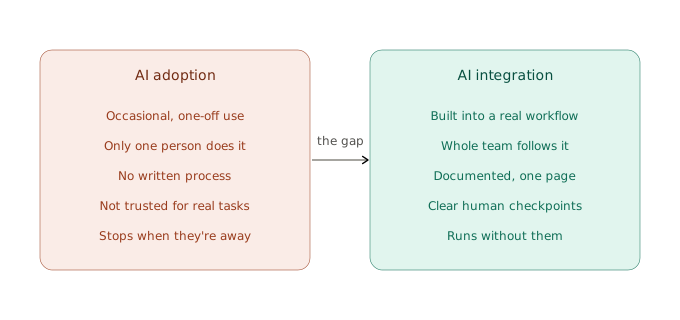
AI adoption means someone at your company has used an AI tool — for an email, a graphic, a summary. It's occasional, personal, and undocumented.
AI integration means AI is embedded in an actual business workflow — with defined inputs, human checkpoints, and a repeatable process that runs whether or not the one person who "gets AI" is in the office that day.
Most small businesses have achieved adoption. Very few have achieved integration. Confusing the two is exactly why so many owners feel like AI "isn't really working" — they've adopted a tool without ever building the system around it.
Why Small Businesses Struggle to Move Past Casual AI Use
It isn't a motivation problem — small business owners are clearly willing to try AI. The real barriers are more structural:
1. Nobody taught the "after the first prompt" part. Typing a question into a chatbot is easy. Deciding which parts of your actual workflow — customer replies, scheduling, reporting, follow-ups — should run through AI, and building a repeatable process around that, is a completely different skill. Most owners never got past step one.
2. Trust hasn't caught up to capability. Many business owners have watched AI do genuinely useful work, but still double-check everything it produces before it goes near a customer or a client. That caution is often reasonable — but without a clear process for what to verify and what to trust, the caution turns into avoidance, and the tool quietly stops getting used for anything that matters.
3. Time, not cost, is the real barrier. It's tempting to assume adoption is about budget. In practice, the more common obstacle is simply not having the time to learn a tool properly while running a business day to day. AI gets squeezed into spare five-minute gaps instead of being deliberately built into how the business operates.
4. There's no "next step" being offered. Most advice online stops at "try ChatGPT for your marketing." Almost nothing walks a business owner from casual use toward an actual operational system — which is precisely the part that determines whether AI becomes a real advantage or stays a novelty.
You've used ChatGPT to draft an email. Maybe Claude has written some marketing copy, or an AI tool cleaned up a spreadsheet. So why does it feel like artificial intelligence hasn't actually changed anything about how your business runs?
You're not imagining it — and you're not alone. Across the United States, United Kingdom, and Pakistan, the vast majority of small businesses have now touched AI in some form. But recent data tells a strange, consistent story: businesses that use AI and businesses that have integrated AI are two very different groups — and most companies are stuck in the first one.
This gap — using AI casually versus running your business on it — is quietly becoming the biggest competitive divide in small business today. Here's why it exists, and more importantly, how to close it.
The AI Adoption Gap, in Plain Numbers
Recent data on small business AI usage paints a picture worth sitting with:
The large majority of small businesses now use AI in some capacity — but only a small fraction have it built into their core operations.
Most owners who use AI report it has helped them, yet most also admit they don't fully trust it to run tasks without close supervision.
A significant share of AI-using businesses operate without any real system, strategy, or process for how they use it — just ad hoc prompting whenever someone remembers to.
Put simply: almost everyone has tried the tool. Almost no one has built a system around it. That's the AI adoption gap, and it's exactly where most small businesses lose the advantage AI is supposed to give them.
How to Build an AI Strategy: A 5-Step Framework
You don't need a data science team or a six-figure software budget to move from an occasional AI user to an AI-integrated business. You need a process. Here's one that works for a solo operator or a ten-person team alike.
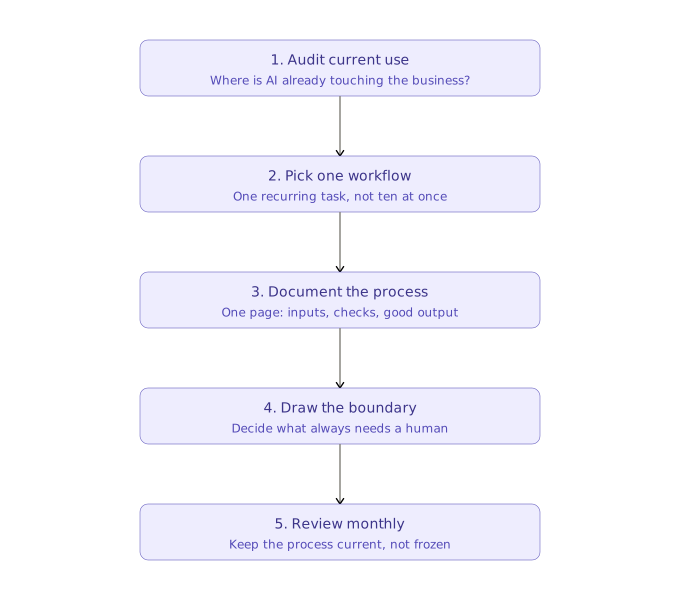
Step 1: Audit where AI is already touching your business — even informally. List every place someone on your team has used an AI tool in the last month, no matter how small. This isn't about judging it — it's about seeing the real starting point, which is usually more scattered than people expect.
Step 2: Pick one repeatable workflow, not ten. The businesses that succeed with AI don't try to automate everything at once. They pick one recurring task — replying to common customer questions, drafting weekly reports, summarizing calls — and build a reliable process around just that one thing before moving to the next.
Step 3: Write the process down. A one-page document that says exactly what gets sent to AI, what gets checked by a human, and what "good output" looks like turns a one-off habit into a system your whole team can follow — and turns AI use from lucky to repeatable.
Step 4: Decide what AI should never touch unsupervised. Real integration isn't "AI does everything." It's knowing precisely where AI adds speed and where a human needs to stay in the loop — pricing decisions, sensitive customer complaints, legal or financial commitments. Drawing that line clearly is what makes the rest of the system trustworthy enough to actually use.
Step 5: Revisit monthly, not yearly. AI tools change quickly. A process that made sense three months ago may now be leaving time on the table. A short monthly check-in — what's working, what's still manual, what new tool might help — keeps the system current instead of frozen in place.
Real-World Examples: Closing the Gap
A small accounting firm in the UK might start by auditing that three different staff members were already using AI informally to draft client emails. Step two picks that single workflow. Step three turns it into a one-page guide: draft with AI, human reviews for tone and accuracy, send. Step four decides that anything involving a client dispute or a tax filing gets no AI drafting at all. Within a month, that one small process is running reliably — and the firm has a template to repeat for the next workflow.
A retail business in Pakistan might do the same with customer WhatsApp inquiries: audit shows AI is already being used ad hoc to answer common questions; the workflow gets formalized with clear escalation rules for anything AI can't confidently answer; a monthly review catches new question patterns to add.
Neither case requires new hires or a big budget. It requires turning something already happening informally into something deliberate.
The Real Opportunity for Small Businesses in 2026
The businesses pulling ahead this year aren't the ones using the most AI tools — they're the ones with the clearest system for using a few of them well. That's genuinely good news for small and solo businesses: this gap isn't closed with money, it's closed with a process, and a process is something any business — regardless of size or location — can build starting this week.
If your business has been "using AI" for a while without feeling like anything has really changed, that's not a sign AI doesn't work for you. It's a sign you're standing exactly where most businesses are right now — one step before the part that actually matters.
Frequently Asked Questions
What is the difference between AI adoption and AI integration? AI adoption is casual, individual use of an AI tool for one-off tasks. AI integration is building AI into an actual repeatable business workflow with clear rules for what it handles and what a human checks.
Why do small businesses struggle to use AI effectively? Most struggle not from lack of interest but from lack of a system — no time set aside to build a process, no clear line between what AI can handle alone and what needs human review, and no follow-up plan to keep the process current.
How can a small business create an AI strategy without a big budget? Start by auditing where AI is already being used informally, then formalize just one workflow at a time with a simple written process. A strategy is a system, not a purchase — it doesn't require new software or headcount to begin.
Is AI trustworthy enough to use without human review? For most small businesses, no — not yet, and not for everything. The safest approach is deciding upfront which tasks (customer-facing replies, internal drafts) can run with lighter review and which (pricing, legal, sensitive complaints) should always have a human in the loop.
Does the AI adoption gap look different in the US, UK, and Pakistan? The underlying behavior is nearly identical — casual use without a system — though awareness and available tooling vary slightly by region. The fix is the same everywhere: pick one workflow, document it, and review it monthly.
House of Digital Solutions (HODS) helps small businesses build practical, reliable software and AI systems — not just tools, but the workflows around them. Explore our affordable digital marketing services or browse more guides like this one on the HODS blog.
How We See This Gap Play Out With Clients
We didn't write this from a stats page — we wrote it from a pattern we keep seeing directly. At House of Digital Solutions, most of the small business owners who come to us for a small business AI audit are already past the "should we try AI" question. They're stuck exactly where this article describes: three tools, no process, one person holding it all together in their head.
Our own free WhatsApp Business Setup Wizard exists because of this pattern — it's the smallest possible version of Step 2 above, a single formalized workflow, not a platform overhaul. When we move into full AI chatbot development, it's rarely about adding more AI — it's about taking a workflow that already exists informally (like the Pakistan WhatsApp example) and giving it the structure from Step 3 and Step 4: a documented process and a clear line for what still needs a human.
The same is true on the operations side. When a client's real bottleneck isn't AI at all but five disconnected tools that don't talk to each other, that's when a small business AI strategy consultation turns into a conversation about custom ERP solutions instead — because no amount of AI prompting fixes a structural gap.
Ready to Grow Your Startup?
Partner with House of Digital Solutions, a digital marketing agency for startups that understands your journey. Whether you're launching your first product, seeking your initial customers, or scaling to the next level, HODS provides the online marketing services for small business that drive real, measurable growth.
POLICIES
SIGN UP
email: info@hods.io
Call : +92 318 249 5037
© 2025. All rights reserved by House of Digital Solutions
+44 759 968 2726
IMPACT
sales@hods.io
support@hods.io